Sunday, April 27, 2014

10th century BC

World in 1 000 BC
Source: wikimedia commons
My last week post was about China rulers in X century BC. I've realized that it will be interesting to find out what happened this times in other civilization. I based on Wikipedia article and make additional investigation on interesting facts and figures. Below I summarize my findings.

Starting in Asia:
Japan - Late Jōmon culture entered in final period (1 000 - 300 BC) 
India - in X century BC there were four Iron Age kingdoms in India—Panchala, Kuru , Kosala, Videha.
Sri Lanka - first capital of the Kingdom of RajarataAnuradhapura - was established

Sunday, April 20, 2014

Rare bird and mythical quest in Chinese Zhou dynasty

King Zhao of Zhou
Source: wikimedia commons
In the time of third Chinese dynasty Zhou - fourth king Zhao rules in the second part of X century BC. He was rather lazy - prefer pleasure than politics. In center of his interest were rather rare plants and animals than ruling country. This passion pushed him to attack rival Kingdom of Chu as he got information about rare bird observed on Chu territory. After crossing the Han River, King Zhao realized that this was a trick. Lack of preparation and weak commanding skills lead to tragic results as describe in John Keay book:

Sunday, April 13, 2014

Timber and Fire - How Jerusalem was captured by Crusaders

Ercole de Roberti Destruction of Jerusalem
Source: wikimedia commons
Mid-June 1099 - Genoese fleet anchored at Jaffa, at this time just small natural harbour, closest to Jerusalem. They had come primary to explore new avenues for commerce. For Baldwin, crusaders leader in this time, they provide needed naval power. He offered them generous term - they can create independent trading enclave in any settlement or city taken by Crusaders with sailors help. In addition experienced and  skilled Genoese craftsman strengthen engineering skills of Crusaders which combined with local Christian knowledge about timber sources allow Crusaders to start building siege machinery. Muslim used normal tactic to fight this timber siege towers - fire but sometimes with unexpected role change:

Sunday, April 6, 2014

Medieval Britain post

XVth century scribe at work (modern reconstruction)
Source: wikimedia commons
How letters were sent in 15th century on British Isles describe Deborah Thorpe in September 2013 BBC History Magazine. 
Not surprisingly the reason of sending letters in those times wasn't much different than today. People sending the letter in every topic starting from business related to love affairs. However, there were many challenges in process of getting a letter from sender to recipients. First one was to find the right person suitable to write the letter as not everyone was capable to do this. 

Sunday, March 30, 2014

Antioch 1098 AD - Bohemond and Firuz

Antioch fortifications
Source: wikimedia commons
Early autumn 1097 - Crusaders army enter northern Syria and arriving at one of the great cities of the Orient, the fortified metropolis of AntiochYaghi-Siyan, Seljuk governor of Antioch well informed by his spies try to protect his city be expelling Christians from city:
"Yagi-Siyan, a man famous for his big hairy ears and thick, grey beard did his outmost to keep the enemy out [of Antioch]. But he knew any of the local Christians may be persuaded to let the Franks [Crusaders] in. When he heard about approach of the Franks he was not sure how the Christian people of the city would react. So he send all the Muslim outside the city walls to dig trenches, and the next day, he send the Christian by themselves to do the same task. When they are ready to return home at the end of the day, he refused to let them in" Source: THE CRUSADES: CRESCENT & THE CROSS, History Channel

Sunday, March 23, 2014

How wool influence British economy

Women sheering sheep for wool fleece.
Source: wikimedia commons
10 million wool fleeces yearly were exported from England in beginning of 14th century ... that's a lot - and make England the world biggest wool producer in those time. But is not only quantity but also quality:
English farmers had developed breeds of sheep that produced fleeces of varying weight and quality, some of which were among the best in Europe. Source: History's big numbers, interviews by Charlotte Hodgman, BBC History Magazine 2/2014
Increasing demands from continental trade center  - Ypres, Ghent, Bruges (all nowadays in Belgium) - requires also good organisation.  Key role plays here monasteries which not only kept theirs own herds but also contracted flocks from peasants leaving in surrounding villages. To make it happen new occupancy like woolman or woolmongers where created. Especially in this area specialized are Cisterian monasteries  - it was integral to the order economy - sheep not only provided wool, which could be used to make clothing and blankets for the community, or else sold, but were important for the manufacture of butter and cheese. 

Sunday, March 16, 2014

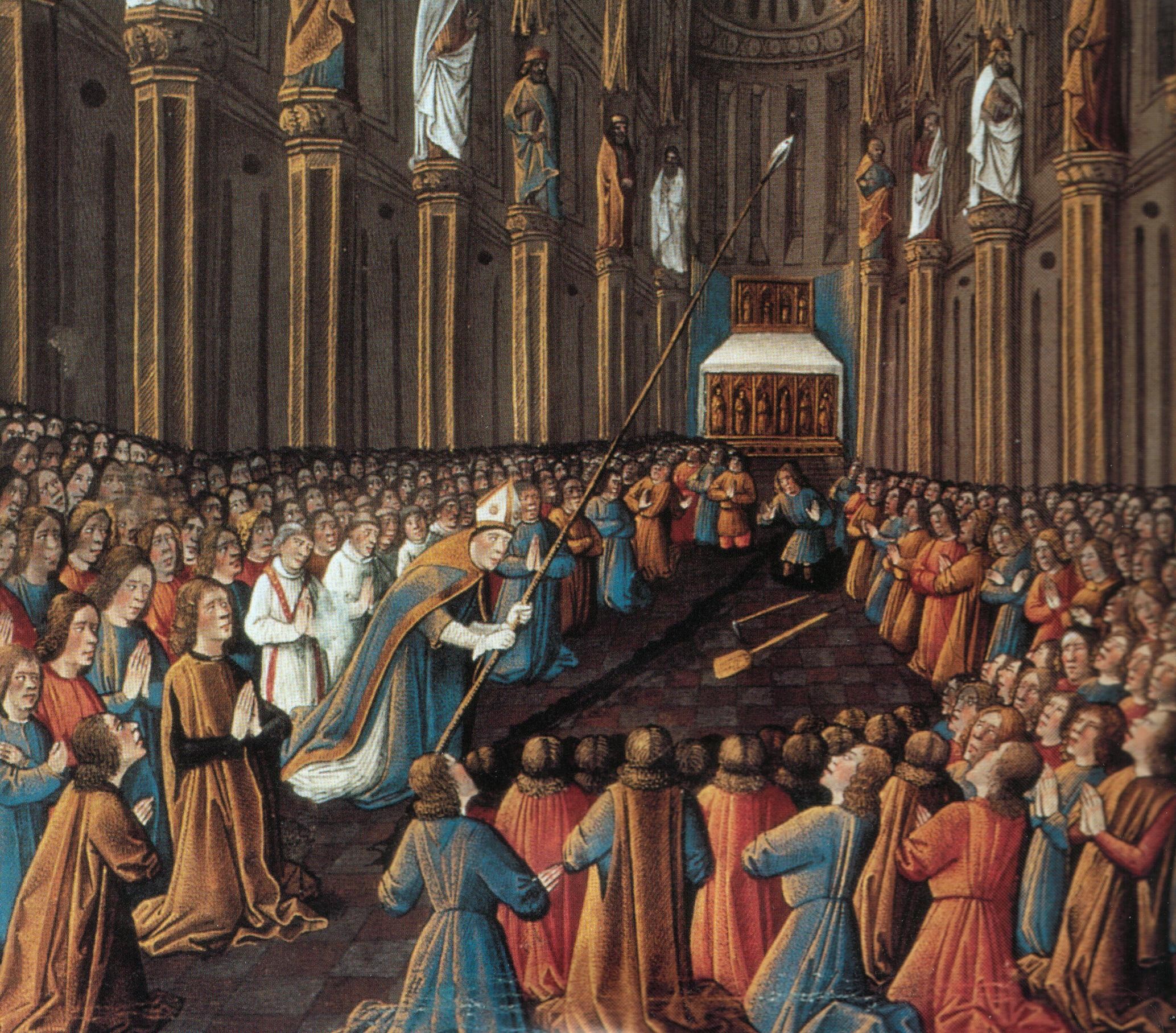
Holy Lance

Bishop Ademar of Le Puy holding Holy Lance
in St. Peter Church, Antioch
Source: wikimedia commons
June 15th,1098 - Peter Bartholomew, French peasant crusader discover Holy Lance in besieged by Muslim city of Antioch, in Church of St. Peter. At least he claimed it but for sure gave faith to Crusaders Knights that they can go outside city walls and defeat Muslim army.
Holy Lance was acclaimed as spear that pierced Jesus side on the cross. It was believed that lance were kept in Jerusalem, however after Romans destroyed city was lost.

The spiritual leader of crusaders bishop Le Puy was skeptical (as one Holy Lance was already kept in Hagia Sophia) but as army morale was raised he hide his hesitation. When he died couple days later he was buried in the very the same place where Holy Lance  had been found.